
What Is Forest Bathing? A Beginner's Guide to Shinrin-Yoku in the UK
There is a moment, usually about ten minutes in, when the urge to check your phone fades and something else takes over. You notice the smell of wet leaf mould. You hear rain ticking on your hood, then a wood pigeon somewhere behind it. Your shoulders come down a centimetre. That small shift in attention is the whole point of forest bathing, and it costs nothing to practise.
What forest bathing actually is
Shinrin-yoku translates roughly as "forest bathing" or "taking in the forest atmosphere". The term was coined in Japan in the early 1980s, when the country's forestry agency began promoting time among trees as a counterweight to city life. The bathing part is deliberate: you soak in the environment through your senses rather than marching through it on the way to somewhere else.
So there is no distance to cover, no summit, no route to tick off. You might cover 400 metres in an hour. You might sit still for most of it. And you do not need ancient woodland to do it — a park with a few mature oaks, a canal towpath lined with willows, or a scrubby pocket of council woodland all work, because the practice depends on attention rather than acreage.
It is also worth saying what it is not. It is not a workout, a foraging trip or a nature documentary. You are not trying to identify anything or achieve anything. You are letting a place reach you.
Why slowing down feels different
Most walks are tasks. You have a target — the top of the hill, the pub, the step count — and your attention narrows to the path in front of you and the clock in your head. Forest bathing widens that attention instead. Instead of asking "how far", you ask "what's here".
People often describe the same three things afterwards: their breathing slows, their shoulders drop, and their thoughts get quieter and less repetitive. Do not expect a revelation. The first ten minutes are frequently boring, and that is not a sign you are doing it wrong. Boredom is usually just the noise of a busy head running out of momentum.
Forest bathing sits alongside professional care rather than replacing it. If you are managing a physical health condition or your mental health is in a difficult place, speak to your GP or another qualified professional about what is right for you.
How to try it: a first session
- Pick somewhere small and close. A wood you can reach in fifteen minutes will get used. A beauty spot two hours away probably will not.
- Set a timer, not a route. Twenty to thirty minutes is plenty for a first go. Knowing the timer will bring you back stops you checking the clock.
- Walk at half your normal pace. If you feel slightly ridiculous, you are about right. Let your feet land softly.
- Sit down for a third of the time. Find a log, a bench or a dry patch of ground and stay put for ten minutes. Sitting is where most of the effect happens.
- Put the phone on aeroplane mode. Not silent — you will still feel it buzz. If you are using it as your timer, keep it in a pocket.
- Finish with something warm. A flask of tea back at the car park turns a nice idea into a habit.
Forest bathing in the rain
British woodland is often at its best damp. Light rain lifts the smell of bark, moss and leaf litter, softens the sound of the world beyond the trees, and empties the place of other people. A wet wood is quieter and, oddly, more intimate than a dry one.
The kit matters more than the weather. A waterproof jacket with a hood beats an umbrella on narrow paths, and boots with actual grip beat fashion trainers on wet roots and clay. Skip cotton jeans — they hold water and chill you. Take a small dry bag for phone and keys, and check the forecast before you go.
Safety, briefly: avoid woodland in high winds or named storms, because falling branches are the real risk, not the rain. Tell someone where you are going and when you expect to be back. Stick to established paths when the ground is slick. If the forecast is a downpour with gusts, walk in a park with open ground instead, or go another day. Light rain is lovely; a weather warning is not.
What to pay attention to
If your mind wanders, give it a job. Work through this list slowly — one prompt every few minutes is plenty.
- Touch: the temperature of the air on your face, the roughness of bark, the give of moss under a thumb.
- Sound: the nearest sound, the middle distance, the furthest thing you can hear. Then the quiet underneath all three.
- Smell: wet earth, pine resin, decaying leaves, the mineral smell of a stream.
- Movement: how light shifts through a canopy, the sway of bracken, a squirrel's route along a branch.
- One tree: choose a single tree and stay with it for five minutes. Notice more about it than you thought there was to notice.
Finding somewhere near you
Woodland Trust woods, National Trust estates, Wildlife Trust reserves and many council-owned copses are free or cheap to visit, and most have a car park or a bus stop within walking distance. Churchyards and old railway lines are underrated. So is a single large tree on a bench-lined street, if that is what is available today.
In England and Wales, stick to public footpaths, bridleways and permissive paths, and check signs at the entrance — access is not the same everywhere. Scotland has broader rights of responsible access, and Northern Ireland has its own arrangements, so a quick look at a local council or access website before you set off saves an awkward conversation.
Common mistakes worth avoiding
- Turning it into a hike. If you are out of breath, you have left the practice behind.
- Headphones. Music is fine on other walks. Here, it drowns the thing you came for.
- Waiting for perfect conditions. There is no ideal season, weather or wood. Drizzle in February counts.
- Documenting everything. Take one photo if you must, then put the camera away.
- Saving it for a big occasion. Twenty minutes on a Tuesday will do more for you than a three-hour trip twice a year.
Start this week: a thirty-minute plan
Choose a day, choose the nearest patch of trees, and give it half an hour. Ten minutes walking slowly, fifteen sitting somewhere dry, five walking back. Wear something waterproof, leave the phone in your pocket, and resist the urge to make it useful.
If it rains, go anyway. That is not a compromise — it may be the best version of the walk you get all month. And if you find it hard to settle, that is normal, and it is exactly the reason a short session once a week beats one long, perfect afternoon.
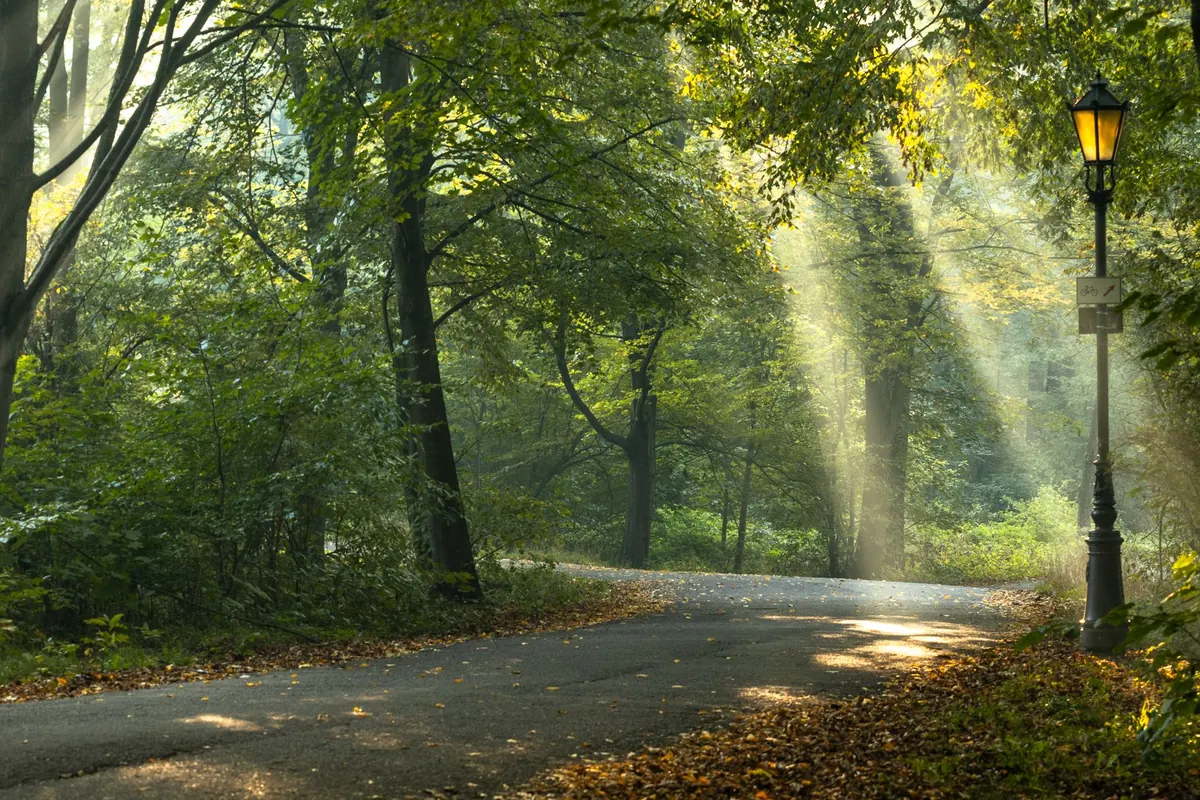
Photo: Dawid Zawiła / Pexels